


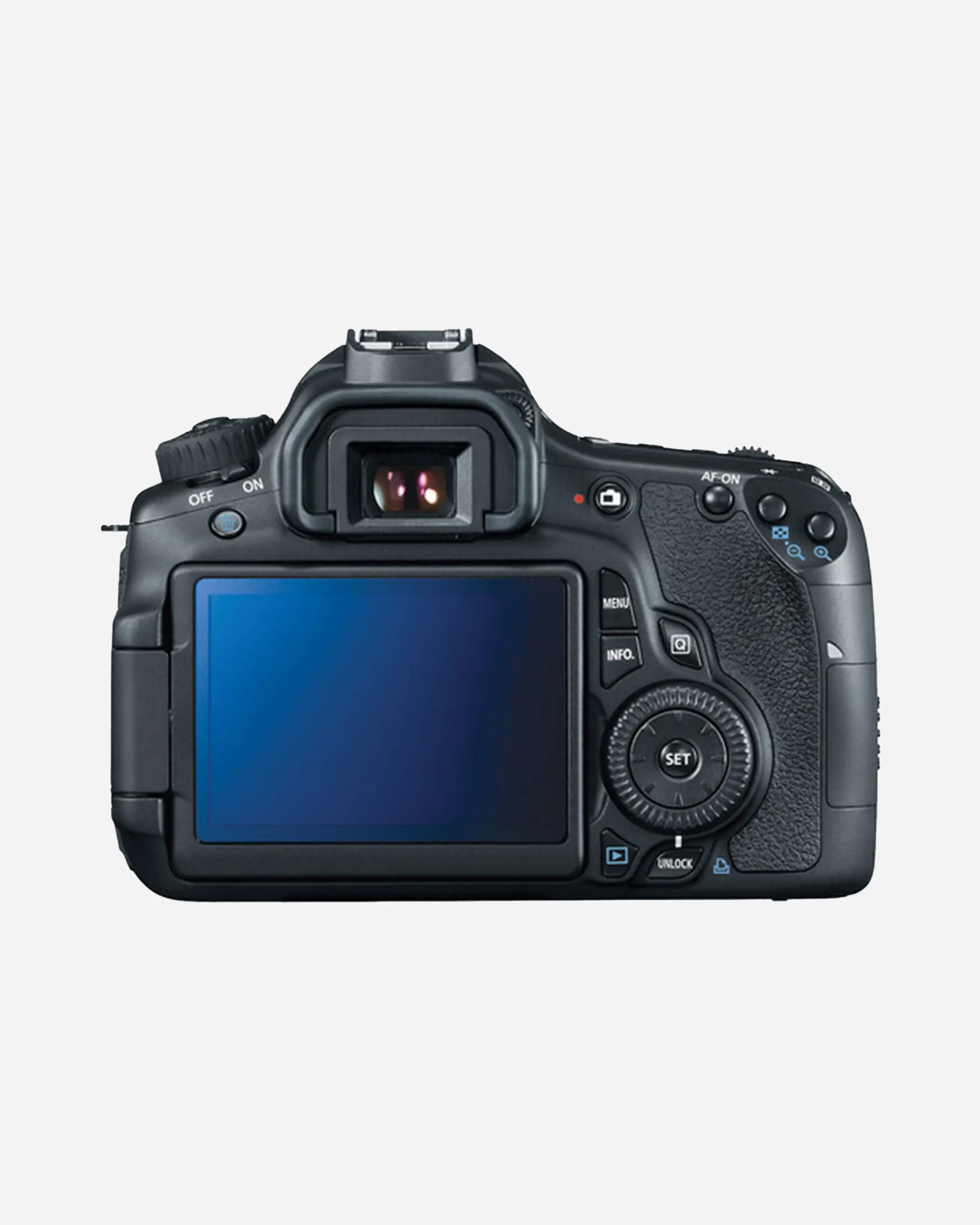


Canon EOS 60D DSLR Camera
The Canon EOS 60D was praised for its excellent balance of features, ergonomic design, and the innovative flip-out screen, making it ideal for travel, portraits, landscapes, events, and creative video work. It offered strong image quality with vibrant Canon colors and performed well in moderate lighting. The camera remains a capable used option in 2026 for beginners or as a secondary body, thanks to its vast lens ecosystem and straightforward operation.
- Delivered Today. (Order Mon-Sat before 12:00pm, delivery before 6:00pm within Lagos)
- Free Store Pick up Available.
- 7 Days Free Returns.
- 24/7 Live Customer Support
Description
The Canon EOS 60D (announced August 2010), a mid-range APS-C DSLR aimed at enthusiast photographers. It introduced several user-friendly innovations for its time, including the first vari-angle LCD in the EOS xxD series, while delivering solid image quality and creative flexibility.
Key Highlights
• 18 MP APS-C CMOS sensor for detailed stills with good color and dynamic range.
• Vari-angle 3.0-inch Clear View LCD (1.04 million dots, 3:2 aspect ratio) — fully articulating for high/low-angle shooting and video.
• Full HD 1080p video recording with manual controls and external mic input.
• 9-point all cross-type AF system for reliable focusing through the optical viewfinder.
• 5.3 fps continuous shooting (up to ~58 JPEGs or 16 RAW).
• ISO 100–6400 (expandable to H: 12800) with DIGIC 4 processor.
• iFCL metering with 63-zone dual-layer sensor for accurate exposures.
• Creative features: In-camera RAW processing, Creative Filters (e.g., Toy Camera, Miniature), Auto Lighting Optimizer, and peripheral illumination correction.
• Compatible with full EF/EF-S lens lineup (1.6x crop factor).
Sensor and Image Processor
• Sensor: 18.0 MP effective (19.0 MP total) APS-C CMOS (22.3 × 14.9 mm). Pixel size ~4.3 μm.
• Processor: DIGIC 4.
• File formats: JPEG, 14-bit RAW, RAW + JPEG.
• ISO range: 100–6400 native, expandable to 12800.
• Dynamic range: Solid for its era, with good highlight/shadow recovery at base ISO.
Still Photography Performance
• Continuous shooting: 5.3 fps (max burst ~58 Large JPEGs or ~16 RAW).
• Autofocus: 9-point all cross-type phase-detection AF (center point more sensitive with f/2.8 lenses). Modes: One-Shot, AI Servo, AI Focus. Working range: -0.5 to 18 EV.
• Metering: 63-zone iFCL TTL metering (evaluative, partial, spot, center-weighted).
• Shutter speed: 30 s to 1/8000 s, Bulb mode; flash sync at 1/250 s.
• Viewfinder: Pentaprism optical with ~96% coverage and 0.95x magnification.
• Other: Active D-Lighting equivalent (Auto Lighting Optimizer), Picture Styles, multiple exposure, HDR mode (basic), and in-camera editing.
Video Recording
• Max resolutions: Full HD 1080p at 24/25/30 fps; 720p at 50/60 fps; 480p available.
• Format: MOV (H.264) with mono built-in microphone; external stereo mic input (3.5mm).
• Video features: Manual exposure control in Movie mode, but contrast-detection AF in Live View is slow (no continuous video AF like later Dual Pixel systems). HDMI output for external monitoring/recording.
Design and Ergonomics
• Body: Polycarbonate with some magnesium elements; not fully weather-sealed (basic dust/moisture resistance).
• Dimensions: Approx. 144.5 × 105.8 × 78.6 mm (5.7 × 4.2 × 3.1 in).
• Weight: Approx. 755 g (with battery and card) / ~675 g body only.
• LCD: 3.0-inch vari-angle TFT, 1,040,000 dots, with anti-reflective coating.
• Controls: Intuitive with Quick Control dial (combined with multi-controller), dedicated buttons, and mode dial with lock.
• Media: Single SD/SDHC/SDXC card slot.
• Flash: Built-in pop-up (GN ~13 at ISO 100); hot shoe with wireless E-TTL II control for external Speedlites.
• Connectivity: HDMI mini, USB 2.0, external mic jack, remote control terminal. No built-in Wi-Fi (Eye-Fi card support or external adapters possible).
Power and Battery Life
• Battery: LP-E6 Li-ion (CIPA rating: ~1,100 shots with viewfinder; significantly less in Live View/video).
• Optional: BG-E9 battery grip (supports two LP-E6 or 6 AA batteries).
Limitations (notable in 2026 context):
• Only 9 AF points (no advanced tracking for fast action).
• Slow contrast AF in Live View/video (no Dual Pixel AF).
• Moderate high-ISO performance (noise noticeable above ISO 3200–6400).
• No touchscreen, no in-body stabilization (relies on IS lenses).
• Basic video AF and no 4K.
• Plastic-heavy body compared to higher-end models; limited buffer for long bursts.
Firmware: Latest version is 1.1.2 (released November 2016), with minor improvements for compatibility and stability.
In 2026, the 60D is long discontinued and very affordable on the used market. It pairs well with EF/EF-S lenses like the 17-55mm f/2.8 IS USM, 18-135mm IS, or primes for sharp results. Many users still enjoy it for still photography, though modern mirrorless cameras surpass it in autofocus, low light, and video.
Related products

Sony Cinema Line FX30 Brand New
Original price was: ₦2,750,000.00.₦2,700,000.00Current price is: ₦2,700,000.00.
Feiyu Tech Vlog Pocket 2 Gimbal
Original price was: ₦150,000.00.₦140,000.00Current price is: ₦140,000.00.
Nikon D7100 DSLR Camera
Original price was: ₦900,000.00.₦850,000.00Current price is: ₦850,000.00.
Panasonic DMC-GH5 Hybrid Camera Brand New
Original price was: ₦1,650,000.00.₦1,600,000.00Current price is: ₦1,600,000.00.

Reviews
There are no reviews yet.